How Much Should You Have Saved by 25, 30 and 40 in NZ
By KiwiBudget Team ·
Most savings benchmarks you read were written for someone earning more than you, paying less rent than you, in a country that is not this one. The honest answer to "how much should I have saved by 30 in NZ" is that a single number tells you almost nothing on its own. What matters is which way your balance is moving, and whether you have cover for the week everything goes wrong.
So treat the ages below as checkpoints, not a report card. They are general rules of thumb, not personal financial advice. If you are behind them, you are in good company, and the fix is the same either way.
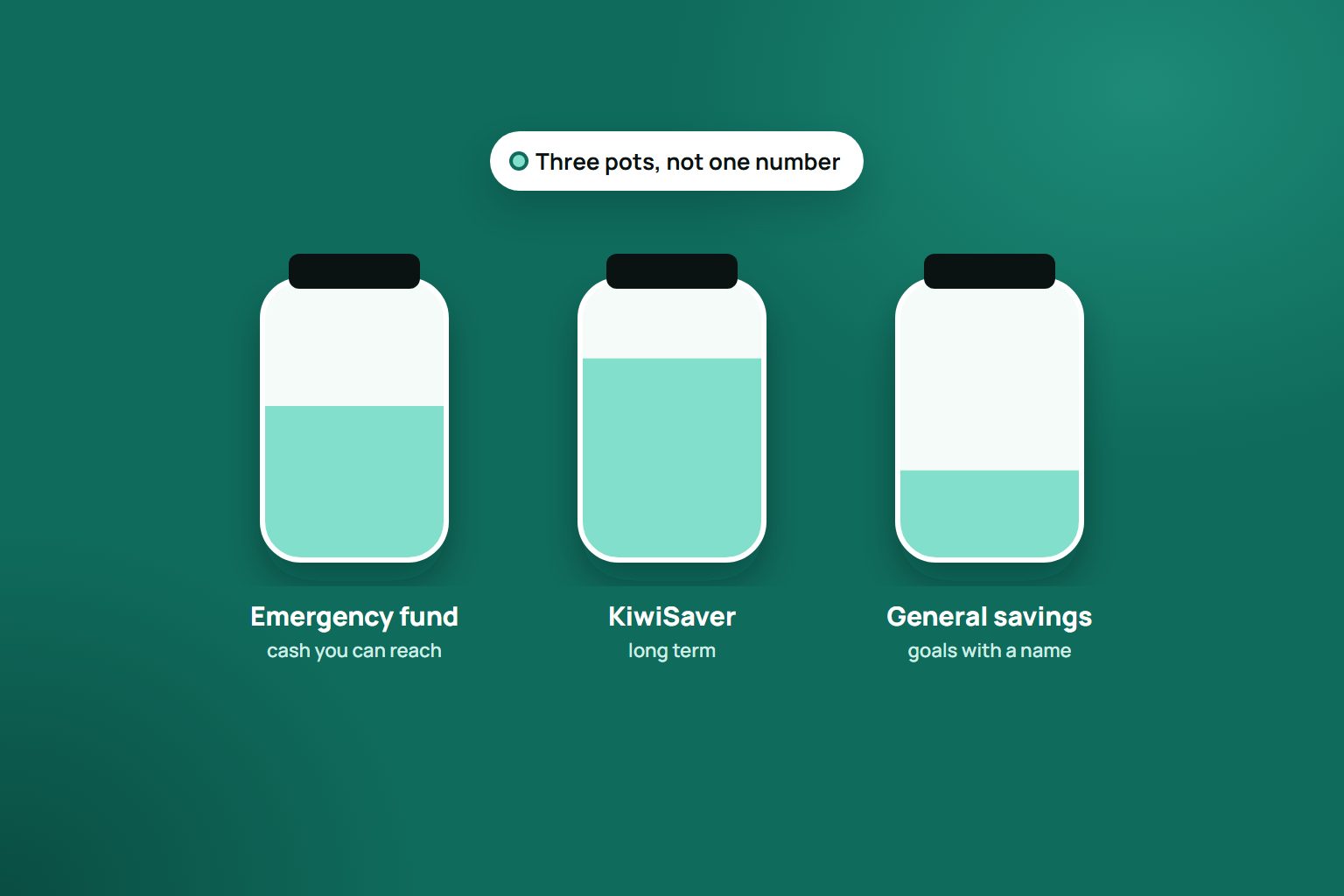
Three pots, not one big number
"Savings" is really three different jobs, and lumping them together is why the total feels so out of reach.
- Your emergency fund. Cash you can reach this week, for the car, the tooth, the sudden gap between jobs. This is the one that changes your life, because it is the difference between a bad week and a bad year on a credit card.
- Your KiwiSaver. Long term, and mostly locked until 65. Once you have been a member for three years you can usually take some out towards your first home, and there are a few other exceptions, such as significant financial hardship or serious illness. It grows quietly whether you look at it or not, which is exactly why people forget to check their contribution rate and fund.
- Your general savings. Everything with a name on it: a car, a trip, a house deposit, a buffer that is not strictly an emergency.
You do not need all three firing at once. Early on, a small emergency fund matters far more than a big KiwiSaver balance. Track them separately so you can see which one needs attention.
By 25: a foothold, not a fortune
At 25, plenty of people are on entry wages, paying off a student loan, and handing most of their pay to a landlord. If that is you, do not measure yourself against a house deposit.
- A starter emergency fund. Sorted suggests starting with $1,000 in its own account and treating it as untouchable. Once that is there, about one month of essential spending is a genuine next milestone.
- KiwiSaver ticking over. If you are employed and contributing, your employer generally has to put in at least 3.5 percent of your pay as well. If you earn $180,000 or less, the government also adds 25 cents for every dollar you contribute between 1 July and 30 June, up to $260.72 a year, which takes $1,042.86 of your own contributions to get in full. Check you are actually in, and that you know which fund your money is in.
- The habit, more than the total. A small automatic transfer the day after payday matters more at 25 than any balance. You are building the machine, not filling it yet.
If your general savings are near zero at 25 but your emergency fund is growing, you are doing fine.
By 30: a real cushion
By 30, incomes often lift a little, and the goal shifts from "start" to "steady".
- Three months of essential spending, in cash. Sorted's longer-term guide is three to six months of expenses, so three months of the bare essentials is the number worth chasing hardest. Essentials means rent, power, food, transport and minimum debt payments, not your whole lifestyle.
- A KiwiSaver balance that is clearly building. One widely quoted guideline, from the US investment firm Fidelity, suggests about a year of your salary in retirement savings by 30. It was built for Americans (it assumes you save 15 percent of your pay from age 25 and retire at 67), and New Zealand has NZ Super from 65, so treat it as a stretch goal, not a verdict. With high rents through your twenties, plenty of sensible people are nowhere near it. Sorted's free KiwiSaver calculator gives you a New Zealand estimate based on your own numbers.
- A named general-savings goal. A car fund, a travel fund, or the first slice of a house deposit. One clear target beats money drifting in and out of your everyday account.
If you can only move one thing at 30, make it the emergency fund. It protects everything else.
By 40: momentum you can feel
By 40, compounding starts to do visible work, and the emphasis moves to not going backwards.
- A fully stocked emergency fund. Three to six months of essential spending, depending on how stable your income is. Sorted suggests the higher end, up to six months, if you are self-employed or your income is irregular, and single-income households may want to lean that way too.
- Retirement savings with real weight. The same Fidelity guideline says around three times your salary by 40. Again, a direction, not a pass mark. If you started KiwiSaver late, or took years out to raise kids, your number will be lower, and that is a fact, not a failure.
- Debt heading the right way. High-interest debt should be shrinking, not growing. A mortgage is a different animal from a maxed-out credit card, so do not treat them the same. Our debt snowball guide shows one way to line repayments up with payday.
When you are behind, which is plenty of people
Here is the part the benchmark articles skip. Plenty of New Zealanders are behind at least one of these numbers. Te Ara Ahunga Ora, the Retirement Commission, found that 62 percent of New Zealanders had an emergency fund in the year to June 2026, which means close to four in ten did not. And Stats NZ found that average household housing costs rose 31 percent between 2020 and 2024, while disposable incomes rose 24 percent.
Being behind is not a character flaw, and panicking about it does not add a cent. What actually moves the needle is boring and repeatable:
- Pick one number to grow. Start with the emergency fund. Everything else can wait a season.
- Automate it. Set up a recurring transfer into a separate savings account, timed to your weekly or fortnightly pay, so the decision gets made once.
- Check your KiwiSaver rate and fund. Two minutes that can matter more over thirty years than any amount of budgeting. Our guide to KiwiSaver contributions covers the current rates, and Sorted's KiwiSaver fund finder compares funds and fees.
- Measure the trend, not the total. If your balance is higher than it was three months ago, you are winning, whatever a chart says a 30-year-old "should" have.
If debt or bills are already getting on top of you, MoneyTalks offers free help on 0800 345 123.
Key Takeaways
- There is no single right number. The three pots (emergency fund, KiwiSaver, general savings) each do a different job, so track them separately.
- By 25, aim for a foothold: a starter emergency fund of around $1,000, KiwiSaver ticking over, and the savings habit itself.
- By 30, aim for around three months of essential spending in cash, with KiwiSaver clearly building.
- By 40, aim for a fully stocked emergency fund of three to six months and retirement savings with real weight.
- The age benchmarks are rules of thumb, not verdicts. Plenty of people are behind at least one, and the fix is the same: automate one number and watch the trend.
- If you can only grow one pot, grow the emergency fund. It protects all the others.
Working out what you can set aside each week is easier once you know what is safe to spend first. KiwiBudget shows what is safe to spend until your next payday, and it launches 16 November 2026 with a Free plan. Create your account.