The Best Budget Split for NZ Renters
By KiwiBudget Team ·
The 50/30/20 rule says put half your take-home pay towards needs, 30 percent towards wants and 20 percent into savings. It is a popular rule of thumb, and even Sorted says it does not work for everyone. It falls apart when rent alone takes 40 percent or more of what comes in, and for a lot of New Zealand renters it does. In the year to June 2025, Stats NZ found that 57.7 percent of lower-income renting households (disposable income under $72,600 a year) spent at least 40 percent of their income on housing costs. When housing swallows most of your needs bucket on its own, you need a split built for how you actually live.
Why 50/30/20 does not work when you rent
The rule assumes rent, power, food, transport and insurance all fit inside half your pay. Sorted suggests keeping rent to 30 percent or less of your budget where you can, but admits that is not always possible in more expensive regions. For many renters right now, rent on its own can be close to half before a single bill is paid.
- Needs blow past 50 percent. Once rent takes 40 percent or more, adding power, internet, phone, transport and groceries pushes your essentials well past half. The bucket was never big enough.
- The savings target stops making sense. If needs really take 65 percent, saving 20 percent leaves just 15 percent for everything else. So people give up on the split, or feel like they are failing at it every payday.
- Wants get squeezed to nothing. A 30 percent wants bucket is not realistic either, so the rule stops describing your life within a fortnight.
A budget you abandon in two weeks is worse than a rougher one you keep. The fix is a split that starts from the number you cannot change.
Start with rent, then split what is left
Rent is fixed. You cannot negotiate it down each week, so treat it as the anchor and build around it instead of forcing it into a tidy percentage.
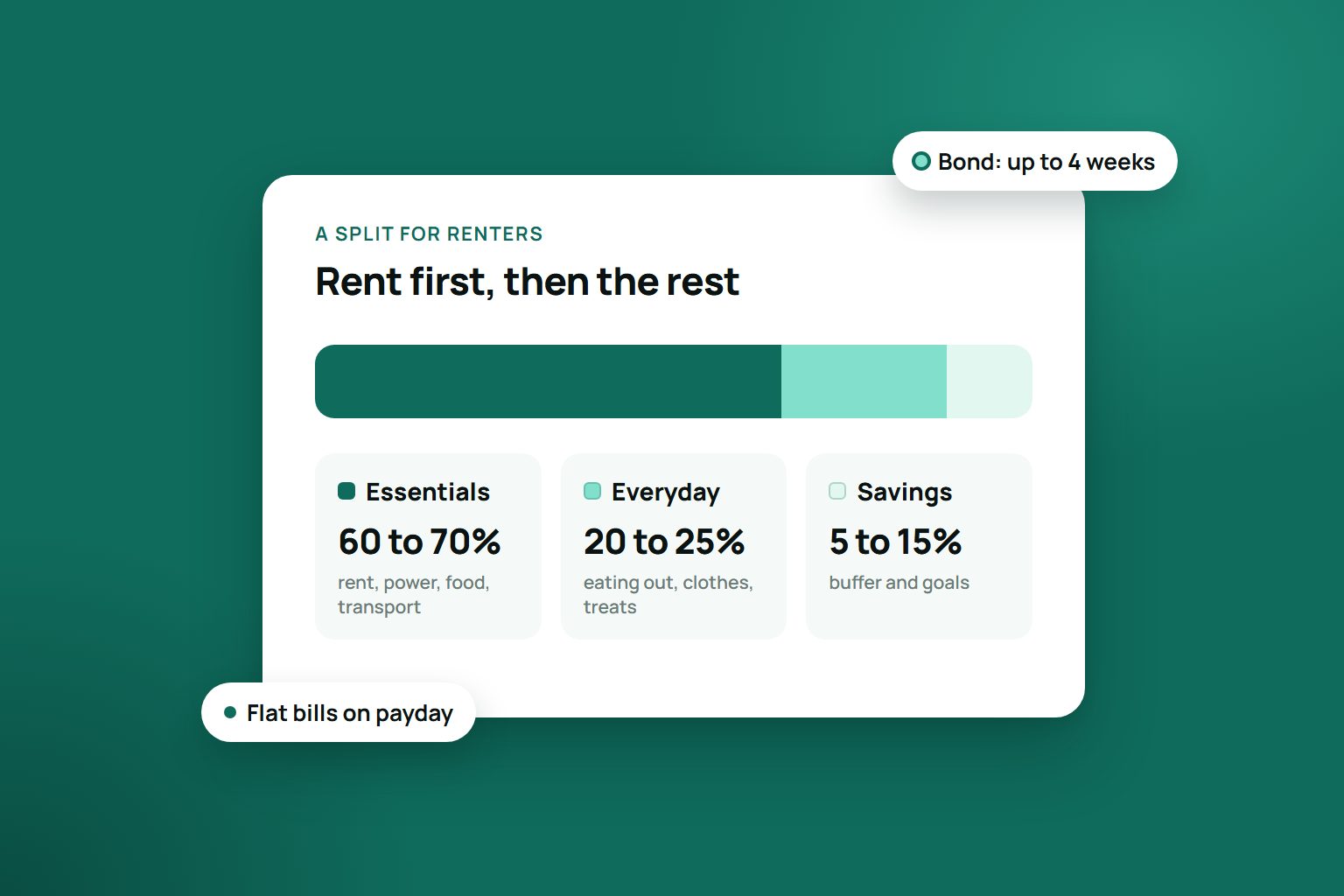
As a rough guide (our own rule of thumb, not an official standard), a realistic renter split looks more like this:
- Essentials: 60 to 70 percent. Rent, power, internet, phone, transport, insurance, minimum debt payments and a baseline grocery figure. Rent is the biggest slice inside this, not a separate thing.
- Everyday spending: 20 to 25 percent. Food beyond the basics, eating out, subscriptions, clothes, the occasional treat. This is the bucket you flex when things are tight.
- Savings and buffer: 5 to 15 percent. Whatever is genuinely left. Five percent you keep every payday beats twenty percent you raid by Thursday.
If you like a shorthand, 60/25/15 is a reasonable starting point, but the exact numbers matter less than the order. Cover the fixed things, protect a small amount of saving, and let everyday spending absorb the rest.
Handle flat bills before they cause a fight
Shared bills are where a lot of renter budgets quietly break, because the money leaves one person's account and trickles back from everyone else.
- Set up a shared account or a fixed weekly transfer. Everyone pays their share in on the day pay lands, before it can be spent. An automatic payment set up once in your banking app does the remembering for you.
- Split the predictable bills evenly, square the variable ones monthly. Rent and internet are fixed. Power swings with winter, so settle it when the bill arrives rather than guessing.
- Name who owns each bill. One flatmate holds the power account, one holds internet. The account holder chases the money, so spread that load rather than dumping it on one person.
If you are the one paying a full bill and collecting from flatmates, budget your own share only. The money coming in from them is not yours to spend, even though it lands in your account.
Bond and the first few weeks
Moving in costs far more than one week's rent, and that lump is what catches people out.
- Bond is capped at four weeks' rent. A landlord does not have to charge a bond, but if they do, four weeks' rent is the most they can ask. Since 1 December 2025, a landlord who agrees to you keeping a pet can also ask for a separate pet bond of up to two weeks' rent.
- Rent in advance is capped at two weeks. It is unlawful for a landlord to ask for more than two weeks' rent in advance. Add that to a full bond and you could need up to six weeks' rent at once, or eight with a pet bond, so budget for both together. Letting fees are banned, so nobody can charge you just for being given the tenancy.
- Bond is lodged, not kept by the landlord. If you pay it to the landlord, they must lodge it with Tenancy Services within 23 working days, and Tenancy Services holds it during the tenancy. You should get a confirmation by email or letter, so follow it up if nothing arrives. Treat bond as money locked away, not money you still have.
- Do an inspection report and photos on day one. Tenancy Services recommends a property inspection report that you and the landlord both sign, plus photos. Damage recorded at the start cannot be blamed on you later, so five minutes of photos when you move in can protect several weeks of rent.
Because moving is so front-loaded, a small moving fund is worth building before you need it.
Build a buffer, even a tiny one
A buffer is the difference between a surprise car repair being annoying and being a crisis. When rent is high you cannot build a big one fast, so build a small one reliably.
- Start with one automatic transfer on payday. Even a small amount, moved to a separate account the day you are paid, adds up without you deciding each time.
- Aim for one week of rent first. Sorted suggests a starter emergency fund of $1,000, then building towards three to six months of expenses. On a rent-heavy budget that bigger goal can feel impossible, so one week of rent set aside is a real, reachable first milestone.
- Keep it out of sight. A separate savings account, not your everyday one, so it never starts to feel like spending money.
Make the split easy to stick to
Splits rarely fail on the percentages. They fail on the effort of tracking them by hand every week.
KiwiBudget launches 16 November 2026. On a paid plan it connects read-only to your NZ bank through Akahu, New Zealand's open finance platform, and it sorts your spending into categories using its own list of New Zealand merchants. Its main number is what is safe to spend until your next payday, worked out from your own pay cycle. Instead of checking whether you are still inside 60/25/15, you check one figure and stop doing the maths in your head. Live bank sync starts with the $4 Sync plan, and the Free plan works with manual entry and bank statement uploads.
Key Takeaways
- 50/30/20 assumes rent fits inside half your pay. For many renters it does not, so the standard split sets you up to fail from the start.
- Anchor your budget to rent, then split the rest. As a rough guide, a renter split is closer to 60 to 70 percent essentials, 20 to 25 percent everyday spending, and 5 to 15 percent savings.
- Automate flat bills on payday. Shared money that moves before it can be spent avoids most flat-money arguments.
- Plan for bond plus rent in advance. Bond is capped at four weeks' rent (plus up to two weeks for a pet bond), rent in advance at two weeks, and bond is lodged with Tenancy Services. A move-in inspection report and photos are your best protection when it is time to get it back.
- A small buffer you keep beats a big one you never reach. One week of rent, saved automatically, is a good first milestone.
This is general guidance, not personal financial advice. If rent leaves too little for food and bills, MoneyTalks offers free help on 0800 345 123.
If you would rather see one clear number than juggle percentages in your head, create your KiwiBudget account before it launches on 16 November 2026.