Petrol just hit a record high: what it costs and how to pay less
By Jack Ridder ·
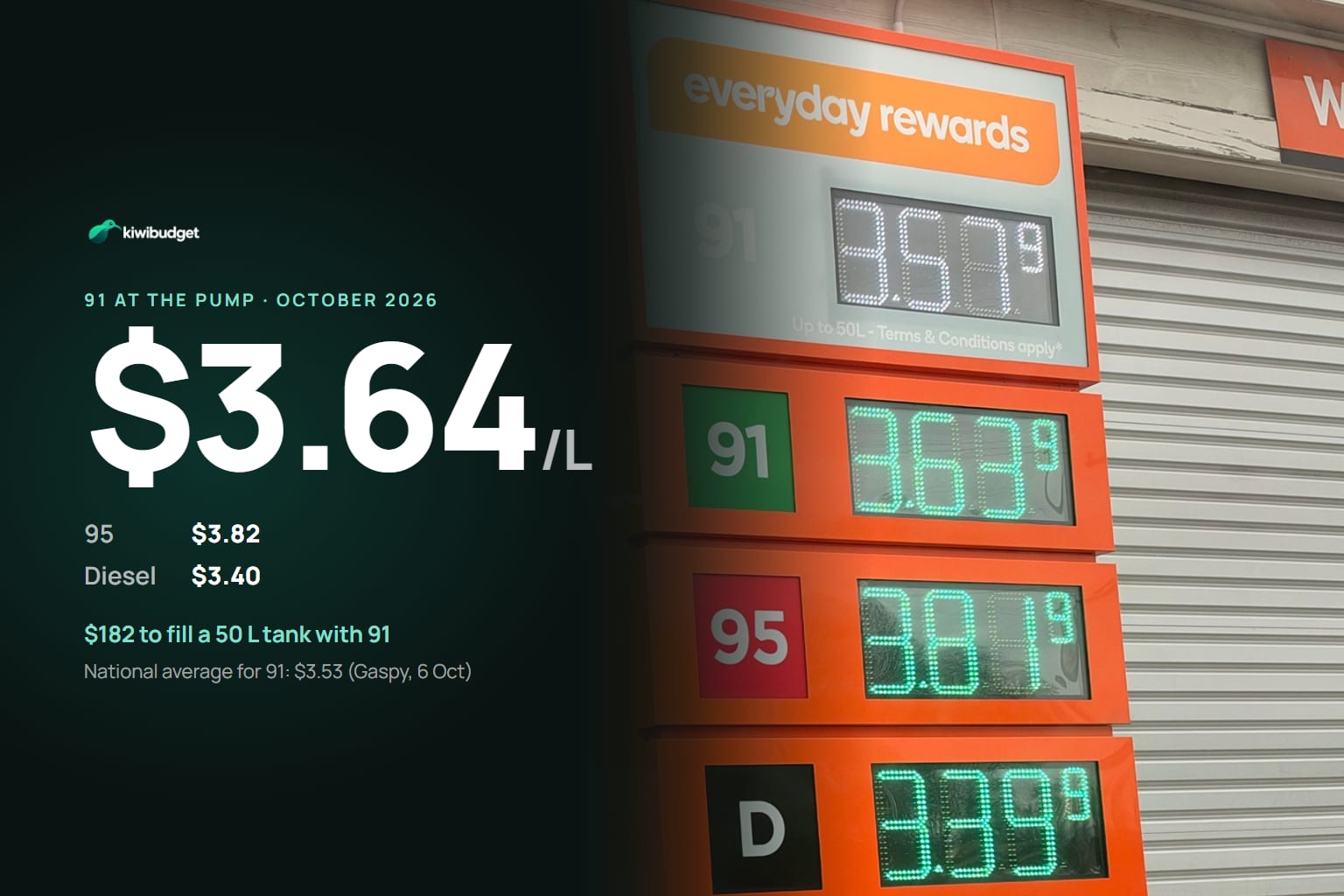
The national average price of 91 passed $3.50 a litre this week. On Tuesday 6 October it was $3.526, according to Gaspy's figures, up about 48c in four weeks and just above April's peak of $3.502. Diesel has moved even faster, up about 50c in the same four weeks.
Plenty of stations are higher than the average. At the one in the photo above, 91 was $3.63.9, 95 was $3.81.9 and diesel was $3.39.9.
What it costs you
- A 50 L tank of 91 costs about $176 at the national average, and $182 at the station in our photo.
- That is about $24 more per tank than four weeks ago.
- Against a year ago, it is about $40 more per tank. MBIE's official weekly figures, which take discounts into account and so run a little lower than pump prices, had 91 at 334.5c a litre in the week to 25 September, against 254.9c a year earlier.
- If you spent $60 a week on fuel this time last year, the same driving now costs about $79 a week. Over a year, that is close to $1,000 more.
- Diesel is up by about two-thirds on a year ago on MBIE's figures, from 186.9c to 308.1c. If you run a diesel ute or van for work, you have felt it.
Why it is happening
Three things are pushing at once.
- Oil is expensive. Brent crude has sat above US$100 a barrel for weeks and was US$101.50 on 5 October. It has been high since the start of the Iran-US war in February.
- Refined petrol is expensive. New Zealand imports its fuel already refined, priced mostly off Singapore. Asia's petrol refining margin hit a record in late September, after China suspended fuel exports for October and refineries in India and South Korea had outages.
- The kiwi dollar is weak. Fuel is bought in US dollars. The NZ dollar is around 56 US cents, down about 7% since August, so every barrel costs more in our money even when the oil price stands still.
Tax is a big part of the price, but it is not what changed. On MBIE's breakdown for the week to 25 September, a litre of 91 carried 77.3c of excise and levies, 12.4c for the Emissions Trading Scheme and 43.6c of GST. That is about 40% of the price. The fixed parts have not moved; GST grows with the price because it is charged on the whole thing.
Is it going to come down?
Nobody knows, so be wary of anyone who says they do. In mid-September the AA's Terry Collins said he did not expect relief before Christmas. Treasury's Budget forecast, which had 91 at $2.71 by December, has already been overtaken.
One thing will not add to it this summer. The government has cancelled the 12c a litre fuel excise rise that was due on 1 January 2027. Smaller 5c rises start from 1 January 2028 instead.
Help you might be entitled to
If you are a working family with children, check your Working for Families payments. The In-Work Tax Credit has a temporary extra $50 a week, which IRD lists as running until 31 March 2027. If you think you qualify and are not getting it, ask IRD.
Pay less for the same litre
Check the price before you fill. Pump prices vary more than most people realise. The station in our photo was 11c a litre above the national average, which is about $5.65 on a 50 L tank. That is more than most loyalty discounts are worth. Gaspy is a free app that shows prices reported by other drivers near you.
Use the discounts you already have.
- Woolworths Everyday Rewards: 6c a litre off at bp, up to 50 L. Check bp's page for the current offer, because it changes.
- Foodstuffs Club+ (New World, Pak'nSave and Four Square): 8c a litre at Z and Caltex, earned once per shopping trip (terms). Club+ replaced Clubcard in July, so old advice about Clubcard fuel discounts no longer applies.
- Pak'nSave fuel vouchers: still available at 33 North Island stores. South Island stores have dropped them.
- AA Smartfuel closed in January 2024. Ignore any guide that still lists it.
On 50 L, 6c off saves $3 and 10c saves $5. Worth having, but a station that is 11c cheaper beats both.
Watch for discount days. Gull and NPD have both run Thursday discount days this year. They change, so check before you plan around one.
Use less of it
From EECA (the Energy Efficiency and Conservation Authority) and the AA:
- Ease off a little on the open road. Dropping from 100 to 90 km/h can save up to 7% of your fuel.
- Check your tyres. Every 5 psi under the recommended pressure adds about 1% to fuel use.
- Take the roof box off when you are not using it. A large cargo box can add more than 15%.
- Combine short trips. A cold engine uses up to 20% more fuel, so three errands in one loop beats three separate trips.
- Drive smoothly. Steady acceleration and braking can save around 10%.
Put the real number in your budget
The common mistake is to keep last year's fuel number in the budget and quietly absorb the difference somewhere else, usually as a bit more on the credit card each week.
Instead, look at the last four weeks of fuel on your bank statement, not what you remember spending, and make that your weekly fuel line. If it has gone from $60 to $79, the extra $19 has to come from somewhere on purpose: a cheaper grocery shop, a paused subscription, one less takeaway. Choosing where it comes from is what stops it coming from your credit card.
That is the number KiwiBudget is built around: what is safe to spend until payday once the bills that have not come out yet are taken off. When fuel takes a bigger bite, you see what is left for the rest of the week, rather than finding out at the end of it.
If fuel costs are pushing you into debt, MoneyTalks is free, confidential and independent: 0800 345 123, text 4029, or help@moneytalks.co.nz.