NZ Tax Brackets 2026: Your Complete Guide
By Jack Ridder ·


These are the 2026/27 NZ tax brackets that apply to the tax year ending 31 March 2027. The rates haven’t changed from 2025/26 — the thresholds are identical — but if your salary has grown, you may be sitting in a higher band than last year.
Each rate applies only to the income inside that band, not your entire earnings.
From 1 April 2026 — tax year 2026/27: The top marginal rate of 39% kicks in at $180,001. Only income above that threshold is taxed at that rate.
| Annual income band | Marginal tax rate |
|---|---|
| $0 – $15,600 | 10.5% |
| $15,601 – $53,500 | 17.5% |
| $53,501 – $78,100 | 30% |
| $78,101 – $180,000 | 33% |
| $180,001 and over | 39% |
Key Takeaways
| Point | Details |
|---|---|
| Five marginal bands from 1 April 2026 | Rates run 10.5%, 17.5%, 30%, 33%, 39% — each rate applies only to income inside that band. |
| Effective rate vs. marginal rate | On a $75,000 salary, total income tax is $14,720.50, giving an effective rate of 19.6%. |
| ACC earner levy on top | 1.75% (GST inclusive) applies to earnings up to $156,641, adding up to $2,741.22 annually. |
| No bracket changes for 2026/27 | Thresholds are identical to 2025/26; bracket creep from wage growth is the main risk to watch. |
| KiwiBudget for tax forecasting | KiwiBudget tracks what actually lands in your account each payday and sorts it automatically, so you can see your real take-home position month to month. |
Table of Contents
- What are the 2026/27 NZ tax brackets in detail?
- How does progressive tax work? Marginal vs. effective rate explained
- How does PAYE work for weekly, fortnightly, and monthly pay?
- How are secondary tax codes used when you have multiple jobs?
- What other deductions reduce your take-home pay?
- Did the NZ tax brackets change for 2026, and what’s coming?
- How do you check or change your tax code?
- Tools to estimate take-home pay and spot bracket creep early
- Why knowing your brackets is the most underrated budgeting move
- KiwiBudget makes tax forecasting part of everyday budgeting
- Sources
What are the 2026/27 NZ tax brackets in detail?
The five bands above are sourced directly from IRD’s tax-rates page and confirmed by TaxPop’s 2026 PAYE rates summary, which notes no change between 2025/26 and 2026/27. The thresholds were last modified in 2024, as noted in PwC’s New Zealand individual tax summary.
For payroll purposes, it helps to see those annual bands converted to common pay frequencies:
Figures are approximate, based on 52 weeks / 26 fortnights / 12 months. IRD tables use rounding conventions that may produce minor differences.
Downloading the official PAYE tables: IRD publishes two deduction-table PDFs. IR340 covers weekly and fortnightly pay; IR341 covers four-weekly and monthly pay. Both are available from the IRD tax-rates page and are updated each April. Download the April 2026 version to match the current tax year.
ACC earner levy: On top of income tax, every employee pays the ACC earner levy — 1.75% (GST inclusive) on earnings up to a liable cap of $156,641 for 2026/27, giving a maximum annual levy of $2,741.22. This is collected through PAYE and appears as a separate line on your payslip.
- Levy rate: 1.75% (GST inclusive)
- Maximum liable earnings: $156,641
- Maximum annual levy: $2,741.22
- Applies to employees and self-employed earners alike
How does progressive tax work? Marginal vs. effective rate explained
Your marginal rate is the rate on your next dollar of income. Your effective rate is total tax paid divided by total income. For almost everyone, the effective rate is noticeably lower than the marginal rate — and that gap is where a lot of confusion lives.
Here’s a step-by-step calculation for a $75,000 salary:
- Band 1: $15,600 × 10.5% = $1,638
- Band 2: ($53,500 – $15,600) = $37,900 × 17.5% = $6,632.50
- Band 3: ($75,000 – $53,500) = $21,500 × 30% = $6,450
- Total income tax: $1,638 + $6,632.50 + $6,450 = $14,720.50
- Effective rate: $14,720.50 ÷ $75,000 = 19.6%
Pro Tip: If a pay rise pushes you into the next bracket, only the income above the threshold is taxed at the higher rate. Your take-home pay always increases with a raise — you never lose money by earning more.
How does PAYE work for weekly, fortnightly, and monthly pay?
PAYE (Pay As You Earn) is the system employers use to deduct income tax and the ACC earner levy from each paycheck before it reaches your bank account. The employer is responsible for calculating and paying the correct amount to IRD on your behalf.
Which table to use:
| Pay frequency | IRD table |
|---|---|
| Weekly | IR340 |
| Fortnightly | IR340 |
| Four-weekly | IR341 |
| Monthly | IR341 |
Worked PAYE example — weekly pay: An employee earning $75,000 per year receives a weekly gross of $1,442.31. Using the IR340 table for the M tax code, the employer looks up the weekly earnings column, finds the matching PAYE deduction, and withholds that amount plus the ACC earner levy component. These figures are illustrative; the IR340 table provides the precise deduction for each dollar range.
PAYE covers income tax and the ACC earner levy. It does not automatically cover KiwiSaver contributions, student loan repayments, or child support — those are separate deductions applied after PAYE is calculated.
How are secondary tax codes used when you have multiple jobs?
If you have more than one source of PAYE income, your primary job uses your main tax code (usually M or M SL if you have a student loan). Every other income source needs a secondary tax code. The secondary code tells your second employer which rate to deduct, based on your estimated total income from all sources.
Secondary codes and the income ranges they correspond to:
| Secondary tax code | Estimated total annual income (all sources) |
|---|---|
| SB | Up to $15,600 |
| S | $15,601 – $53,500 |
| SH | $53,501 – $78,100 |
| ST | $78,101 – $180,000 |
| SA | $180,001 and over |
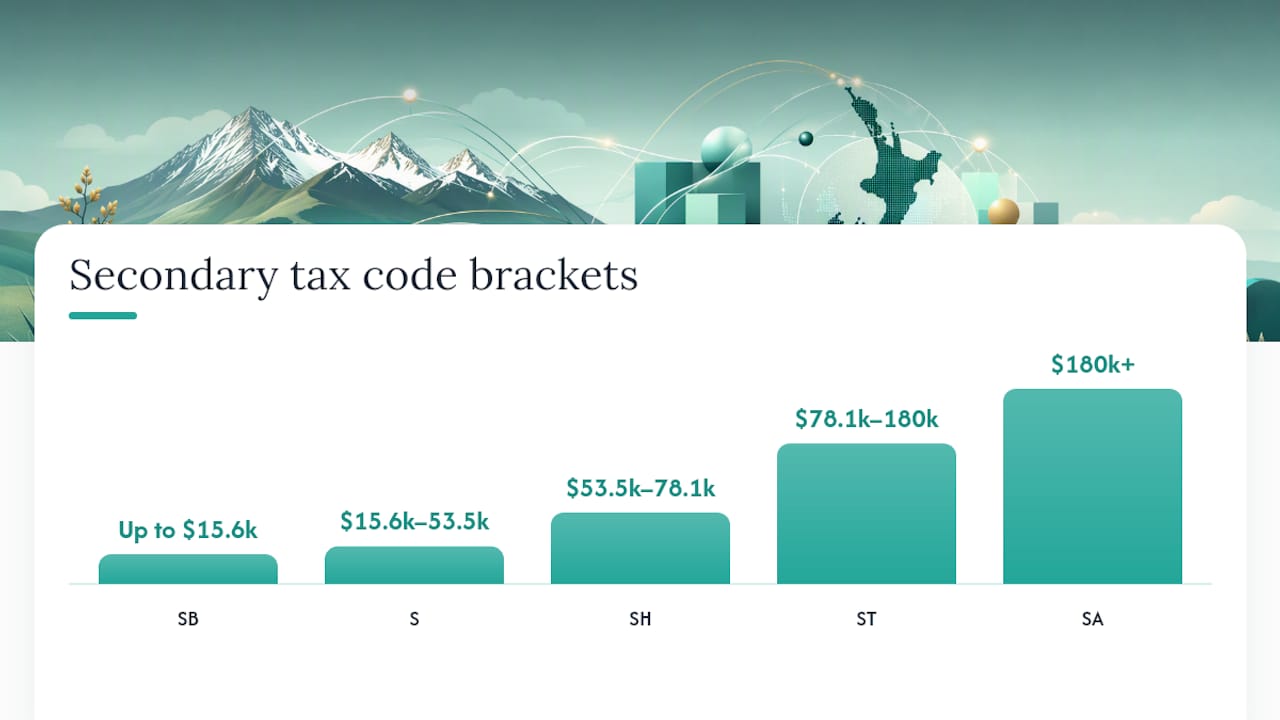
Rates shown are before ACC earner levy, which is added separately.
Practical example: You earn $55,000 at your main job and pick up $10,000 from a second role. Your combined income is $65,000, which sits in the $53,501–$78,100 band.
Getting the code wrong creates problems. Assign a code that’s too low and you’ll face an IR3 tax bill at year-end. Too high and you’ve overpaid and need to claim a refund. Log into myIR to review your codes and update them if your income situation changes mid-year.
What other deductions reduce your take-home pay?
Income tax and the ACC levy are the two deductions calculated through PAYE, but your payslip likely shows more. Here’s what to expect:
- ACC earner levy: 1.75% (GST inclusive) on earnings up to $156,641 — collected through PAYE alongside income tax.
- KiwiSaver employee contributions: You choose 3.5%, 4%, 6%, 8% or 10% of gross pay, with 3% available only as a temporary rate reduction. Your employer adds a minimum 3.5% on top, rising to 4% on 1 April 2028. Contributions are deducted before you see your net pay.
- Student loan repayments: If you have a student loan, 12% is deducted on income above the repayment threshold. The current threshold is set by IRD and updated periodically — check IRD’s student loan pages for the current figure.
- Child support: Deducted by the employer if IRD has issued a deduction notice.
- Other statutory deductions: Court-ordered deductions or voluntary salary-sacrifice arrangements.
The order matters: employers calculate income tax and ACC levy first (PAYE), then apply KiwiSaver and student loan deductions to the gross pay figure. The result is that KiwiSaver contributions reduce your net pay but don’t reduce your taxable income.
Pro Tip: *When estimating disposable income, always include KiwiSaver and student loan deductions alongside PAYE.*
Did the NZ tax brackets change for 2026, and what’s coming?
The short answer: no. The 2026/27 personal income tax brackets are unchanged from 2025/26. The thresholds that apply from 1 April 2026 are the same five bands introduced in 2024.
Timeline:
- 2024: Last threshold adjustment — thresholds were modified, introducing the current five-band structure.
- 2025/26: Bands held at 2024 levels; ACC earner levy adjusted.
- 2026/27 (from 1 April 2026): Brackets unchanged; ACC earner levy remains at 1.75% with the cap rising to $156,641.
- Beyond 2026: No announced threshold changes as of the current tax year.
The real risk isn’t a bracket change — it’s bracket creep. When thresholds stay fixed and wages rise with inflation, more of your income gets taxed at higher marginal rates each year. Over three to five years, that effect compounds quietly. Baker Tilly’s 2026 tax facts note specifically warns about this dynamic.
Pro Tip: Run a quick scenario each April: if your salary increased by the rate of inflation, how much extra tax did you pay compared with the prior year? If the answer is more than a few hundred dollars, it’s worth reviewing your KiwiSaver rate or checking whether any tax credits apply to your situation.
How do you check or change your tax code?
A wrong tax code is one of the most common reasons for unexpected PAYE deductions. Here’s how to fix it:
- Check your payslip. Your tax code appears on every payslip. Common codes: M (main income, no student loan), M SL (main income, student loan), S, SH, ST (secondary income).
- Log into myIR. Go to myIR on the IRD website and request an income summary. This shows total income, PAYE deducted, and any credits or refunds owed.
- Compare PAYE deducted against what you should have paid. Use the bracket table and your total annual income to calculate expected tax. A significant gap means your code is wrong.
- Change your tax code. Download an IR330 (Tax code declaration) from IRD, complete it with the correct code, and hand it to your employer. Changes take effect from the next pay run.
- If you were overcharged: File an IR3 individual tax return or request a personal tax summary through myIR. IRD will calculate the refund and pay it directly to your bank account.
- If you were undercharged: IRD will issue a tax bill. You can pay it in full or set up an installment arrangement through myIR.
Contact IRD directly at 0800 227 774 if you’re unsure which code applies to your situation or if your income is irregular.
Tools to estimate take-home pay and spot bracket creep early
Getting a rough PAYE estimate is straightforward with the right tools. Getting an accurate one — one that includes KiwiSaver, student loan, and ACC levy — takes a few more inputs but is worth the effort.
Useful calculators and resources:
- IRD’s PAYE tables (IR340/IR341): The official source. Download the April 2026 version from IRD’s tax-rates page for exact deduction figures by pay frequency.
- MoneyHub’s PAYE tax rates page: A consumer-friendly explainer with worked examples and a simple calculator for checking net pay.
- Calculate.nz tax rates page: Lists all 2026/27 rates including ACC, ESCT, and GST in one place, with cumulative tax examples.
- BDO’s rates and stats compendium: Detailed payroll-focused reference covering ACC earner levy and ESCT thresholds.
Using KiwiBudget to project take-home pay:
- Connect your bank account in KiwiBudget through a licensed New Zealand open banking provider. The app pulls your income transactions automatically.
- Enter your gross salary, pay frequency, KiwiSaver contribution rate, and student loan status. KiwiBudget calculates your estimated net pay using current 2026/27 rates.
- Run a scenario: increase your salary by 3% and see how net pay changes. The forecasting tool shows whether the increase pushes income into the next bracket and by how much.
If your real purchasing power is flat or declining despite a pay rise, that’s bracket creep in action. KiwiBudget’s forecasting view makes this visible across a 12-month timeline rather than as a single payslip snapshot.
Why knowing your brackets is the most underrated budgeting move
Most people check their net pay once, set up a budget, and forget about it. That works fine until a pay rise, a second job, or a KiwiSaver rate change quietly shifts the numbers. The gap between what you think you take home and what actually lands in your account can run to hundreds of dollars a year — not because anything went wrong, but because the calculation changed and nobody told you.
Knowing your marginal rate also changes how you think about voluntary KiwiSaver contributions. That’s not a reason to max out contributions blindly, but it’s a reason to run the numbers before deciding.
The one thing most bracket explainers skip: your effective rate matters more than your marginal rate for almost every financial decision. Marginal rate tells you the cost of the next dollar earned. Effective rate tells you what you actually kept. Both numbers are worth knowing, and neither takes more than five minutes to calculate with the bracket table above.
This article provides general information about NZ tax brackets and is not personal tax advice. For advice specific to your situation, contact a registered tax professional or IRD directly.
KiwiBudget makes tax forecasting part of everyday budgeting
Knowing the brackets is step one. Seeing how they interact with your actual pay, KiwiSaver rate, and spending patterns is where the real clarity comes from.

KiwiBudget connects to your NZ bank through a licensed open banking provider and pulls your income and spending automatically, so you are not entering figures by hand every month. Its tax calculator uses current IRD rates, so you can check where a change in pay actually leaves you. Set your KiwiSaver contribution rate, flag your student loan status, and KiwiBudget calculates your estimated net pay using the current 2026/27 brackets. The forecasting tool lets you model a salary increase, a second income source, or a change in KiwiSaver rate and see the net-pay impact before it hits your account.
For anyone who discovered a wrong tax code or an unexpected PAYE deduction while reading this, KiwiBudget gives you a running view of what actually lands in your account each payday, so pay that does not match your tax code shows up in month two rather than at year-end. Start tracking your take-home pay with KiwiBudget and run your first bracket scenario today.

Not tax advice. Contact a tax professional or IRD for personal tax matters.
Sources
- Tax rates for individuals
- NZ Tax Brackets and PAYE Tax Rates 2026 | TaxPop
- New Zealand - Individual - Taxes on personal income
- NZ Tax Rates 2026/27 | All PAYE, GST, ACC, ESCT Rates
This article is general information, not a substitute for advice from a qualified financial advisor. Consult a qualified financial professional about your own circumstances before acting on anything here.